How small changes to your surroundings can transform your relationship with food—without the constant battle
If you’re a busy adult juggling work, family, and everything in between, you’ve probably found yourself in this scenario: You sit down with the best intentions to have a reasonable snack or meal, only to look up twenty minutes later wondering where all the food went. Sound familiar?
You’re not broken. You’re not lacking willpower. You’re simply human, navigating a world designed to make us overeat.
The Willpower Myth
For decades, we’ve been told that successful eating is about discipline, motivation, and sheer force of will. But what if I told you that willpower is actually the least reliable strategy for long-term success?
As both a registered dietitian and therapist, I’ve worked with hundreds of clients who describe themselves as “lacking self-control” when it comes to food. The truth is, they’re fighting an uphill battle in environments specifically designed to promote overconsumption.
Research consistently shows that our eating behaviors are heavily influenced by external cues—portion sizes, package sizes, plate sizes, and food visibility. When we rely solely on internal cues like hunger and satiety, we’re essentially bringing a knife to a gunfight.
The Science Behind “Size Matters”
Here’s what researchers have discovered about human eating behavior:
We’re visual creatures. Studies show that people often decide how much they’ll eat before taking their first bite, based largely on what they see in front of them. This means satisfaction, fullness, and even taste play secondary roles to visual cues.
Portion size directly correlates with consumption. The more food placed in front of us, the more we eat—regardless of hunger levels. This phenomenon, known as the “portion size effect,” occurs with both healthy and less healthy foods.
We’re wired to clean our plates. The “clean plate club” mentality runs deeper than childhood habits. Our brains are programmed to see food as a finite resource, triggering an unconscious drive to finish what’s in front of us.
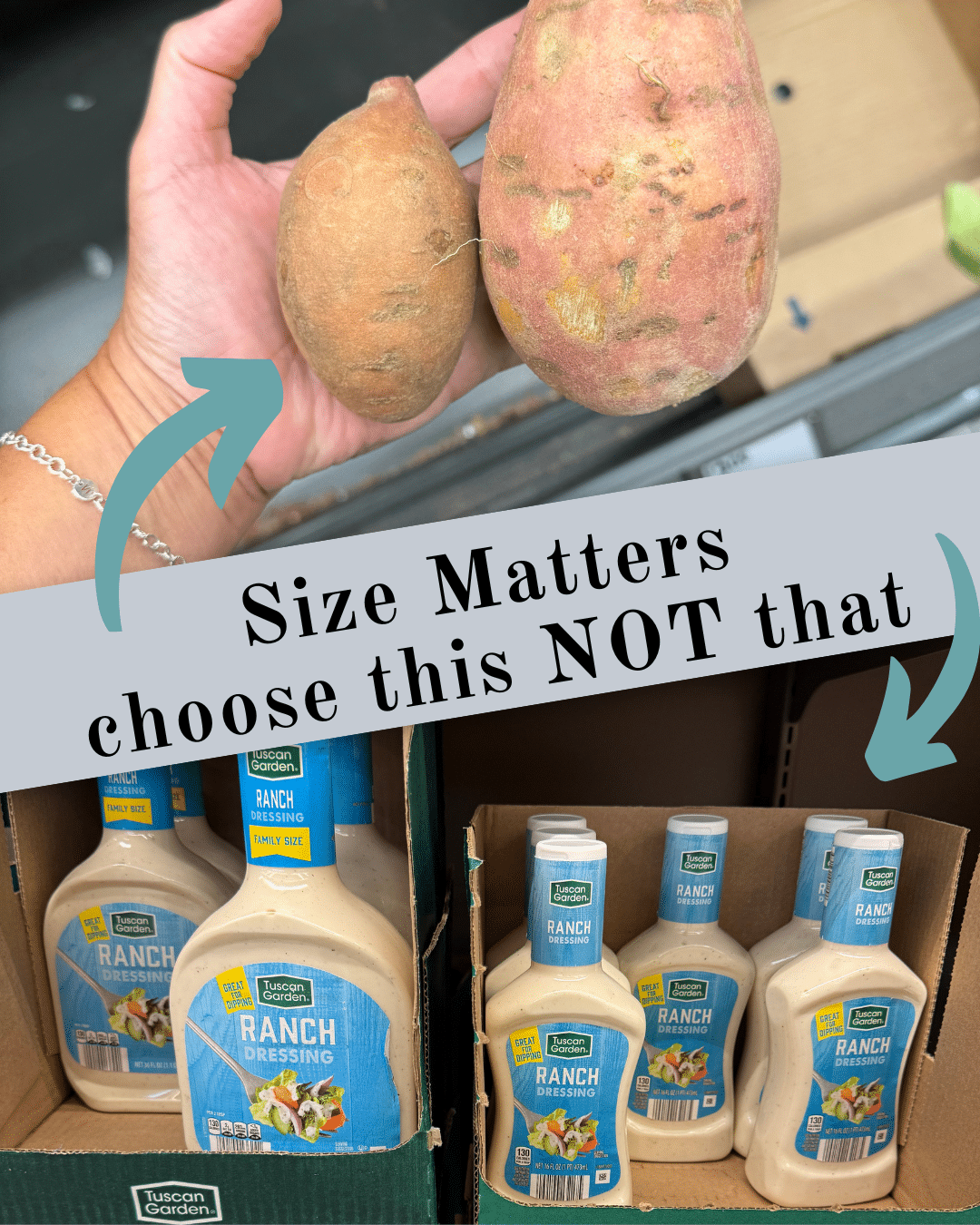
Package size influences usage. Whether it’s breakfast cereal, laundry detergent, or olive oil, we consistently use about 30% more from larger containers compared to standard-sized packages.
The Modern Portion Problem
Today’s food environment makes it nearly impossible to gauge appropriate portions. What we consider “normal” sizes have inflated dramatically over the past few decades:
- Sweet potatoes that look like footballs
- Chicken breasts weighing half a pound each
- Apples the size of softballs
- Single slices of wide-pan bread that technically count as two servings
- Restaurant meals that could feed a family of four
Just last week, I was shopping at Aldi and photographed two sweet potatoes sitting side by side. The smaller one represented an appropriate portion, while the larger one contained 2.5 servings. Most people would grab the bigger potato without a second thought, assuming it’s a single serving.
This portion distortion extends beyond restaurants and packaged foods—it’s infiltrated our entire food system, from grocery stores to our own kitchens.
The Environment vs. Willpower Battle
When you’re already managing work stress, family responsibilities, and the mental load of daily life, the last thing you need is another battle with your willpower. Every decision we make throughout the day depletes our mental resources, a phenomenon psychologists call “decision fatigue.”
By the time evening rolls around—when many of us do our mindless eating—our willpower reserves are essentially empty. This is why the same person who makes excellent food choices at breakfast can find themselves elbow-deep in a bag of chips at 9 PM.
But here’s the empowering truth: You don’t need more willpower. You need a better environment.
Your Complete Environment Makeover: 8 Non-Negotiable Guardrails
1. Ban the Bag (The #1 Game-Changer)
The rule: Never eat directly from large packages—chips, pretzels, popcorn, cookies, crackers, or nuts.
Why it works: When you eat from the package, there’s no natural stopping point. Your brain doesn’t register “a serving”; it registers “the container.”
How to implement: Always portion snacks into a small bowl before eating. Keep measuring cups handy if you need guidance initially, but aim to eyeball appropriate portions over time.
Real-life tip: This is a non-negotiable rule in my home, especially for my kids. It felt restrictive at first, but now it’s automatic—and our snack consumption has naturally decreased without anyone feeling deprived.
2. Avoid the Warehouse Store Trap
The rule: Skip Costco/Sam’s Club-sized packaging when possible, especially for frequently used items.
Why it works: Research consistently shows we use 30% more from supersized containers, negating any cost savings and leading to overconsumption.
The psychology: When we buy in bulk, our brains subconsciously tell us to use more so our “investment” doesn’t go to waste. This applies to everything from cheese blocks to cereal boxes.
Smart alternatives: Buy standard sizes, or if you must buy bulk, immediately divide items into smaller containers when you get home.
3. Clear Your Counters (Out of Sight, Out of Mind)
The rule: Keep all food tucked away in cabinets or pantries.
Why it works: Food visibility is one of the strongest predictors of consumption. Items left on counters become “background snacking” throughout the day.
What to keep: Water, fresh fruit (if you’re trying to increase intake), and perhaps one mindful choice like a small bowl of nuts.
Bonus benefit: A clutter-free kitchen reduces stress and creates a more peaceful cooking environment.
4. Establish Kitchen Boundaries
The rule: Keep all food in the kitchen—no bedroom mini-fridges, desk drawer snacks, or bedside treats.
Why it works: Creating physical barriers between you and food ensures eating requires intentional effort rather than mindless grazing.
The effort principle: If you want to eat, you have to walk to the kitchen, which naturally creates a pause to ask, “Am I actually hungry, or is this emotional/boredom eating?”
Family application: This rule is especially important for kids, helping them develop healthy relationships with food and eating locations.
5. Downsize Your Dishes
The rule: Use smaller plates, bowls, and serving utensils.
The psychology: A reasonable portion looks sad and insufficient on a large plate, prompting us to add more food to “fill” the space. The same portion looks satisfying on a smaller plate.
Practical sizes:
- Use 9-inch plates instead of 12-inch dinner plates
- Choose bowls that hold 1-1.5 cups rather than soup bowl-sized portions
- Opt for smaller serving spoons and ladles
Real-world impact: This single change can reduce consumption by 15-20% without any conscious effort to eat less.
6. Restaurant Strategy: Pack First, Eat Second
The rule: Request a to-go container immediately and pack half your meal before you start eating.
Why restaurants are tricky: Most restaurant portions contain 2-3 servings, but we’re conditioned to finish what’s on our plate.
Alternative approaches:
- Split an entrée with your dining companion
- Order an appetizer and side salad as your main meal
- Ask for lunch portions even at dinner
Mindset shift: You’re not missing out—you’re getting two meals for the price of one.
7. Strategic Serving: Counter vs. Table
The rule: Leave serving dishes and extra food on the counter, not the dining table.
The barrier effect: Wanting seconds requires getting up and making a conscious decision, rather than mindlessly reaching for more food mid-conversation.
Additional benefits:
- Prevents “picking” while talking after you’re satisfied
- Reduces visual cues to continue eating
- Encourages more mindful second helpings
Family dynamics: This strategy works especially well with children, who are highly influenced by food visibility.
8. Workplace Food Environment Audit
The rule: Remove all food from desk drawers and immediate workspace.
Common workplace traps:
- Desk drawer candy stashes
- Communal candy bowls
- Vending machine proximity
- Conference room leftovers
Healthier alternatives:
- Keep emergency snacks in a kitchen area that requires walking
- Replace candy bowls with clementines or nuts
- Bring pre-portioned snacks from home
- Establish “food-free zones” in your workspace
Implementation: Start Small, Think Big
Trying to implement all eight strategies at once is a recipe for overwhelm. Instead, approach this systematically:
Week 1-2: Choose your biggest trigger area. For most people, this is either “ban the bag” or “clear your counters.”
Week 3-4: Add one more strategy, ideally one that complements your first choice.
Month 2: Layer in 2-3 additional strategies as the first ones become automatic.
Month 3 and beyond: Fine-tune and add remaining strategies as needed.
Remember: Progress over perfection. Some weeks will be better than others, and that’s completely normal.
Why This Approach Works Long-Term
Unlike restrictive diets or willpower-based strategies, environmental changes work with your brain rather than against it. They:
- Reduce decision fatigue by making healthy choices automatic
- Work when you’re stressed because they don’t require mental energy
- Benefit your entire family without feeling punitive
- Save money by reducing food waste and overconsumption
- Feel sustainable because they’re about changing your surroundings, not restricting yourself
Beyond the Kitchen: The Ripple Effect
When you successfully modify your food environment, something interesting happens: you start feeling more in control in other areas of your life too. Clients often report:
- Improved confidence in their ability to make lasting changes
- Better sleep patterns (less evening overeating)
- Increased energy throughout the day
- Reduced guilt and shame around food choices
- More mental space for other priorities
This isn’t about perfection—it’s about creating an environment that supports your goals rather than sabotaging them.
The Bottom Line: Small Changes, Significant Results
Size truly does matter, but not in the way diet culture has taught us. Instead of focusing on the size of your body or the size of your willpower, focus on the size of your portions and the setup of your environment.
These eight strategies cost nothing to implement but can fundamentally transform your relationship with food. When your environment works for you instead of against you, healthy eating becomes less about constant vigilance and more about natural, sustainable habits.
You’re already juggling enough in your busy life. Let your environment do the heavy lifting when it comes to supporting your health goals.
Ready to take action? Choose one strategy that resonates most with you and commit to implementing it this week. Small steps, taken consistently, create the biggest transformations.